
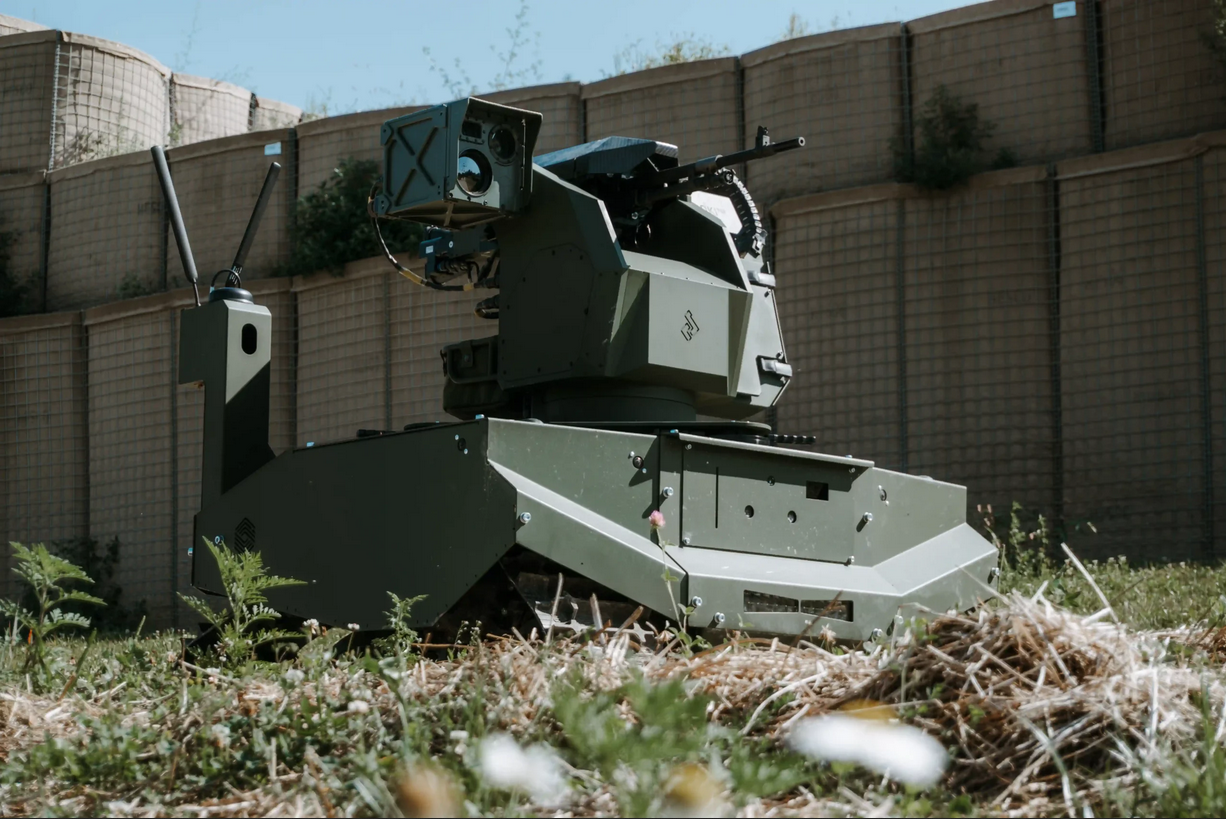
Combat Gereon UGV developed by ARX Robotics. Source
For the past three years, the defense industry has watched a relentless cycle of innovation in the skies over Ukraine. From the early dominance of the Bayraktar TB2 to the ubiquitous swarm of FPV drones, the “aerial revolution” has been well-documented. However, a second, quieter revolution is currently reaching a tipping point on the ground. While much of the media coverage remains focused on dramatic “gun-bot” videos, industry analysts and military journalists must look deeper.
The real transformation in Ukraine is not merely the arrival of the robotic soldier; it is the fundamental restructuring of operational architecture. The evolution of Unmanned Ground Vehicles (UGVs) from “expendable mules” to “autonomous frontline commanders” is bridging a gap created by the modern drone-dominated airspace, fundamentally altering how armies preserve manpower and project force.
The initial vision for ground robotics, held by both the Ukrainian military and many global powers prior to 2022, was shaped by a century of science fiction: the “mini-tank”. This approach favored heavy, complex, and heavily armed platforms designed to function as direct infantry replacements. Russia’s development of the Uran-9 is the most prominent example of this philosophy—a ten-ton platform armed with a 30mm cannon designed to lead assaults.
However, combat experience exposed the fatal flaws of the mini-tank concept. In high-threat environments, these heavy systems suffered from catastrophic communication lag and limited mobility; operators in Syria reportedly lost signal within 300 to 500 meters if low-rise buildings stood between them and the vehicle. The lesson was clear: high-value, centralized robotic assets were too vulnerable to the realities of a contested battlefield. Ukraine’s eventual success came from discarding this “top-down” model in favor of a “bottom-up” approach—building “FPV drones on wheels” that were simple, low-cost, and modular.
Uran-9 Unmanned Vehicle on the Firing Range. Source.
The pivot toward UGVs was driven by the emergence of the modern “Kill Zone”—an area of constant fire control extending 15–20 kilometers from the line of contact. Within this zone, traditional movement by human-led logistics is “almost certain death” because of persistent drone surveillance.
The situation is further complicated by the widespread use of fiber-optic FPV drones. Unlike radio-controlled drones, these systems are effectively immune to electronic warfare (EW), allowing them to wait for days and ambush targets with surgical precision. This “aerial dome” has made traditional logistics—the delivery of supplies and rotation of personnel—nearly impossible for human soldiers, forcing UGVs to become the “logistical bloodstream” of the front.
The operational necessity of ground robotics was starkly illustrated during the Kursk offensive. Ukrainian forces encountered the Russian elite UAV formation known as “Rubikon,” which systematically dismantled Ukrainian logistics routes using advanced electronic intelligence and strike drones. The damage was so severe that Ukrainian troops noted, “Rubikon has arrived—nobody drives anymore”. This tactical environment forced a radical shift toward UGVs to move food, water, and ammunition to exposed positions when manned trucks were being destroyed at an unsustainable rate.
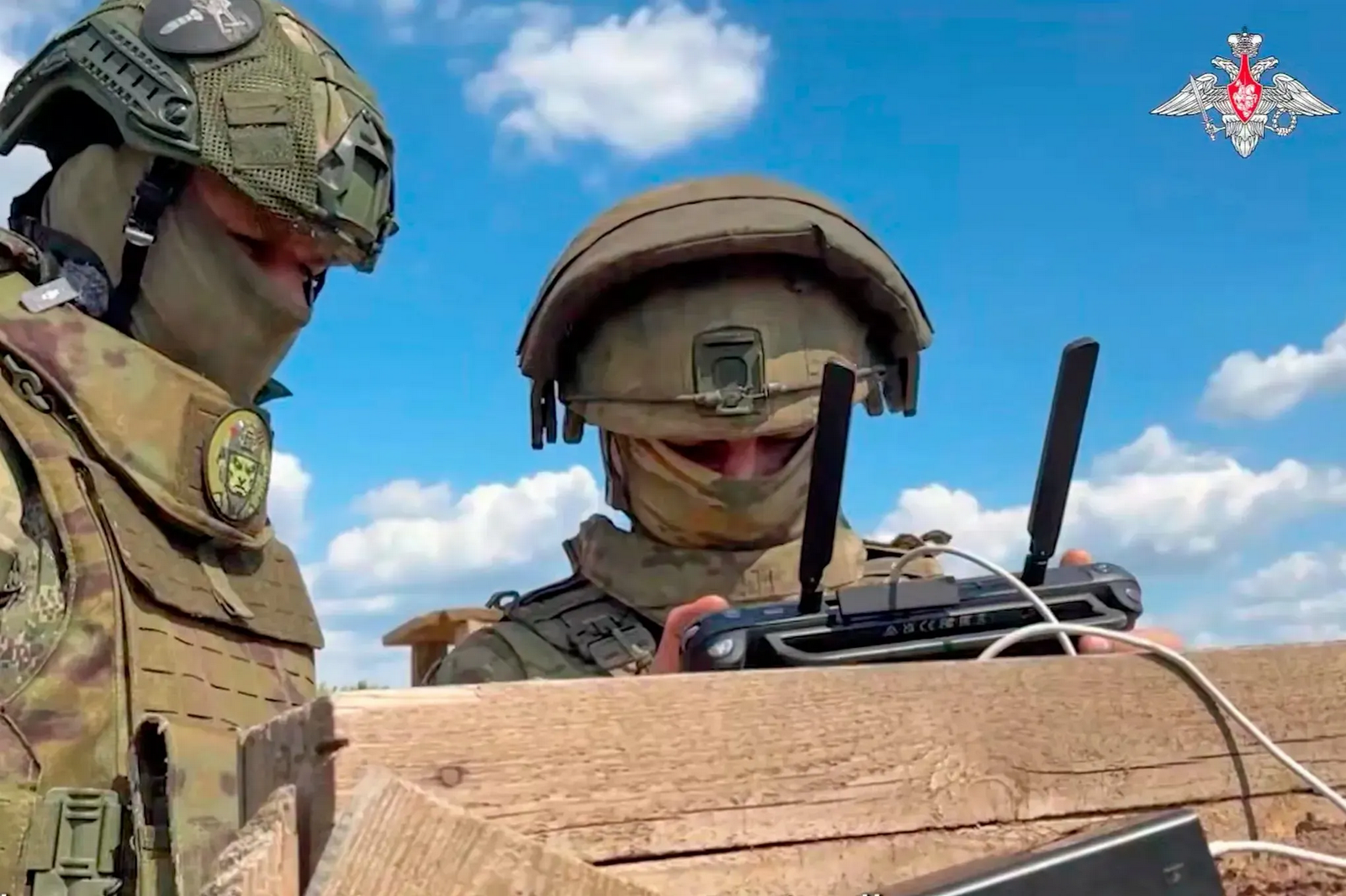
Screen capture of a Russian Ministry of Defense report on the Center for Advanced Unmanned Technologies “Rubicon”. Source
A critical misconception among casual observers is that these robots operate with simple “joystick” ease. In reality, operating a UGV requires extensive manpower and exhaustive mission planning. Unlike aerial drones, ground platforms are critically dependent on precise topographic knowledge; any pit, crater, or trench can immobilize a vehicle and block an entire group.
Ukrainian staff officers emphasize that UGV missions require high-resolution imagery and orthophoto maps with detailed terrain data that must be updated daily, as even a single rainstorm can dramatically change conditions. Furthermore, a single UGV operation is a “complex multi-component process” that requires coordination between aerial reconnaissance, EW teams to protect the signal, and artillery units to suppress enemy UAV takeoff points. Far from being a “low-manpower” solution in the planning stage, these missions often involve expanding teams that conduct multiple “rehearsals” at training grounds to determine exact traversal speeds over specific distances.
The President of Ukraine, Volodymir Zelensky, annouced on the 13th of April 2026 that for the first time in the war, drones captured without allied human combatants an enemy trench. Source
This operational maturity was not achieved in weeks but through years of painstaking trial and error. For example, the successful breakthrough medevac of a wounded soldier from behind enemy lines—a 33-day ordeal—only succeeded on the seventh attempt.
To scale this capability, Ukraine launched aggressive educational campaigns and created specialized training centers. The KillHouse Academy trains pilots in computer simulators for swamp and forest terrains, while the Ukrainian Training and Testing Complex (UTTC) provides obstacle routes to test equipment. This ecosystem has allowed the military to grow from an initial 9 platoons using drones to more than 100 brigades currently employing UGV platforms. Today, 30% of the Ukrainian army has a dedicated UGV company, and several elite units have already formed full UGV battalions, such as the K-2 Regiment. This institutionalization is supported by a massive industrial base comprising over 130 different manufacturers.
The scale of planned deployment for 2026 is unprecedented in military history. The Ukrainian state is targeting a production of 15,000 ground drones through state channels, while another 15,000 will be sourced from the private sector, for a total planned production of 30,000 UGVs in 2026.
However, analysts must recognize the high rate of attrition that accompanies this volume. Data from 2026 indicates that a UGV is typically hit after an average of only 6 or 7 operations. Furthermore, 1 in 8 units are irreparably damaged beyond the point where frontline workshops can restore them. This high turnover is why commanders emphasize that “Ukraine can afford to lose robots, but it simply cannot afford to lose battle-ready soldiers”.
The real revolution is the shift from individual machines to coordinated robotic groups. This has profound operational effects on the preservation of combat power as UGVs are used to “take the first punch,” triggering mines and soaking up initial contact to reduce human casualties. After proving their worth in logistics (which still accounts for 90% of use), UGVs are now modular strike systems. A recent operation saw a logistics UGV repurposed with 12 anti-tank mines to autonomously destroy a fortified building 20km away. Commanders predict that robots will eventually replace one-third of frontline infantry, allowing humans to focus on high-judgment tasks while machines handle the “dirty, dangerous work”. And as the war progresses, we are already seeing the effects of Ukraine’s steady technological investment.
Conclusion
For industry analysts, the success of UGVs in Ukraine is not defined by a single “Terminator” moment, but by the integration of the machine into the scheme of maneuver. Success on the ground is intrinsically linked to how the battlefield has evolved in the air. The “ground drone revolution” is an operational triumph of planning, topographic mastery, and multi-unit coordination over the simple application of firepower. As the war moves through 2026, the edge will remain with the side that can most effectively manage the infrastructure of autonomy while accepting the high cost of trial and error in the most lethal environment on earth.

Analyst in the defense industry offering insights in the drone sector
https://www.theguardian.com/world/2026/apr/04/fighting-robots-give-ukraine-hope-in-war-with-russia
Air3F Presents VARKHAN Unmanned Ground Vehicle With 200 kg Payload
ARX Robotics Unveils Ukrainian-European Combat Gereon UGV to Boost Soldier Survivability
https://nationalinterest.org/blog/buzz/unmanned-ground-vehicles-could-be-next-big-battlefield-disruptor-ps-021226
https://www.bbc.com/news/articles/c62662gzlp8o
https://www.mobilityengineeringtech.com/component/content/article/50439-10-unmanned-ground-vehicles-being-developed-and-tested-around-the-world
A Ukraine ground drone with Browning .50 cal hitting a Russian MT-LB
byu/Youngstown_WuTang inTankPorn
https://united24media.com/latest-news/ground-robots-could-replace-one-third-of-troops-turning-ukrainian-infantry-into-an-elite-force-17112
https://en.defence-ua.com/analysis/key_missions_and_challenges_of_unmanned_ground_vehicles_in_ukraines_war-15129.html
https://en.defence-ua.com/news/murakha_joins_the_fight_ukraines_new_ugv_can_haul_half_a_ton_through_warzones-14983.html
https://www.armyrecognition.com/focus-analysis-conflicts/army/conflicts-in-the-world/russia-ukraine-war-2022/netherlands-expands-ukraines-reactivity-with-more-than-150-new-themis-ugvs
https://www.ukrinform.net/rubric-defense/4110246-over-9000-frontline-missions-in-march-ukraines-defense-forces-expanding-use-of-ground-robots.html
https://www.armyrecognition.com/news/army-news/2026/russia-expands-courier-ugv-roles-from-thermobaric-strikes-to-bagulnik-82-robotic-mortar-fire-support
https://www.armyrecognition.com/news/army-news/2025/russia-fields-courier-ugv-armed-with-shmel-thermobaric-rocket-module-on-the-ukraine-front
Small Ukrainian "Malyuk" logistics UGV is delivering supplies and ammo to the frontline. The UGV is remote-controlled.
byu/UpgradedSiera6666 inukraine
Some interesting UGVs used by Russian troops in Ukraine.
byu/No-Reception8659 inTankPorn
https://www.army-technology.com/analyst-comment/growing-role-ugvs/
The Sun has Set Over Kyiv on the 1456th Day of the Full-Scale Invasion. Khartiia's UGV operator "Hornet" says his unmanned ground vehicles save about thirteen soldiers’ lives each week
byu/frontliner-ukraine inukraine
UGV in Ukraine — how ground robots are changing modern warfare
byu/Stariy-COM inWeTrueGun
UGVs armed with machine guns being trialed in Russia in March 2025
byu/jacksmachiningreveng inTankPorn
https://en.defence-ua.com/events/ugvs_in_ukrainian_service_how_they_overcome_kill_zone_and_change_rules_of_war-17932.html
https://jamestown.org/ukraine-becomes-world-leader-in-unmanned-ground-vehicles/
Ukraine Unleashes Robotic UGV Capable of Blind Grenade Strikes
https://www.armyrecognition.com/news/army-news/2025/ukraine-fields-combat-ready-ugvs-as-russia-counters-with-its-own-robotic-breaching-units
https://united24media.com/war-in-ukraine/ukraines-first-robot-only-assault-meet-the-fighters-who-pulled-it-off-6375
Ukraine’s Defense Tech Market Hits $6.8B in 2025, Ground Robotic Systems Production Surges 488%
https://www.armyrecognition.com/archives/archives-defense-exhibitions/2026-archives-news-defense-exhibitions/bedex-2026/ukraines-devdroid-unveils-droid-nw-40-ugv-equipped-with-remote-40mm-grenade-launcher-for-european-armies
https://en.defence-ua.com/news/ukraines_largest_protector_ugv_may_be_armed_with_laser_weapons-16974.html
https://en.defence-ua.com/weapon_and_tech/ukrainian_ratel_h_ugv_now_equipped_to_launch_fpv_drones_with_new_four_cell_launcher-17551.html
https://www.defenceprocurementinternational.com/features/land/integrated-modular-unmanned-ground-system
https://www.army-technology.com/analyst-comment/unmanned-ground-vehicles-ugvs/?cf-view
https://breakingdefense.com/2025/08/unmanned-ground-vehicles-real-crucial-in-fight-against-russia-ukrainian-official/
https://en.defence-ua.com/news/why_more_ugvs_will_appear_on_the_frontline_and_what_problem_robotic_systems_address-16826.html
https://www.businessinsider.com/ukraine-ground-robots-troops-uncrewed-ground-vehicles-first-quarter-2026-4
https://snakeisland-institute.s3.eu-north-1.amazonaws.com/Defense+Tech+Monthly+%E2%80%94+August.pdf
https://snakeisland-institute.s3.eu-north-1.amazonaws.com/Defense+Tech+Monthly+%E2%80%94+December.pdf
https://snakeisland-institute.s3.eu-north-1.amazonaws.com/Defense+Tech+Monthly+%E2%80%94+January.pdf
https://snakeisland-institute.s3.eu-north-1.amazonaws.com/Defense+Tech+Monthly+%E2%80%94+June.pdf
https://snakeisland-institute.s3.eu-north-1.amazonaws.com/Defense+Tech+Monthly+%E2%80%94+November.pdf
https://snakeisland-institute.s3.eu-north-1.amazonaws.com/Defense+Tech+Monthly+%E2%80%94+October.pdf
https://x.com/GrandpaRoy2/status/1983169641678770565