
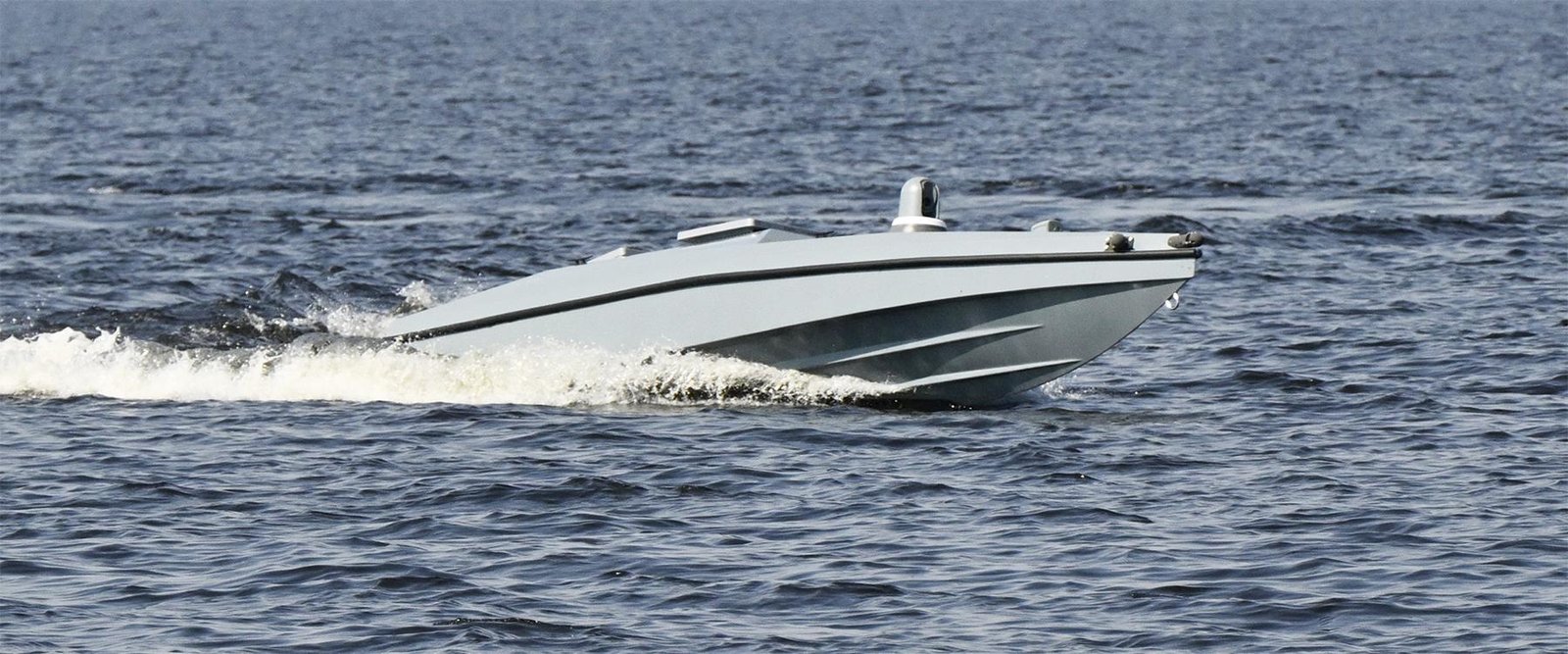
Magura V5 USV drone deployed at sea. Source
Naval procurement cycles had since the the 1990s set themselves in a traditional regularity: a State orders a new class of ships to replace an aging one; the Naval Shipyard designs, produces and adjusts a few things along the way and if everything goes according to plan (looking at you Constellation Class), everybody gets what they want on time.
Or at least, that was until the Ukrainians started using new tools to transform Russia’s surface Black Sea fleet into a permanently stationed underwater fleet. This of course, has not gone unnoticed. Suddenly, countries and unfortunately nefarious organisations around the world, which had until then little means to invest in a modern decked out fleet or enough purchasing power – were offered a new very cost-effective alternative to rethink their positions shifting the paradigm of naval domination and projection around the world by a small club of countries.
As “stealth capabilities” have developed, so have sensors. The increased use of a multitude of sensors have made it harder for conventional fleets to operate undetected which wasn’t a problem until you combine this with the threat of fast, nimble and numerous small drones approaching with aggressive intentions in mind.
The concentration of forces can therefore be a disadvantage today in a naval engagement if force protection measures are not strong enough. All these low-cost drones however do not meaning anything unless there is an edge in the information space, i.e. being able to know where your enemy is before he does.
As such, naval drone carriers have started being developed in these last few years to explore this new segment of warfare. What you may not know is that naval drone carriers are evolving at a rapid pace, redefining themselves what could be considered “traditional” naval drone carriers.
What is Assymetric Warfare?
Asymmetric warfare could be defined as: “a form of warfare in which a non-state actor uses unconventional tools and tactics against a state’s vulnerabilities to achieve disproportionate effect, undermining the state’s will to achieve its strategic objectives”. Source
The very nature of asymmetric warfare makes it difficult to give a precise and consensual definition.
what are the “Traditional Naval Drone Carriers”?
Nations with smaller budgets compared to traditional blue water navies have developed different variants of drone carriers, offering asymmetric capabilities. As always, knowledge on some of the products we talk about is limited, most of the time by design. So it is important to always be careful regarding the reporting of information, especially for an emerging class of weapon systems. Nevertheless, there are three main examples of what we could call “traditional naval drone carriers” currently in service, and as of time of reporting – maybe two.
What is a Naval Drone Carrier?
The simple definition is that it is a crewed or uncrewed ship equipped with a flight deck on which unmanned aerial vehicles (UAVs) can take off and land. More specifically, it gives the ability to a navy to embark, accommodate, transport, monitor, coordinate and recover a large quantity of UAVs without using an aircraft carrier. They are considered modular, acting as a multi-role platform. The term “mothership” has also begun emerging, regarding particularly unmanned surface vessels (USVs) acting as floating platform, which we will explore later on.
In summary, the naval drone carrier is defined by its role as the hub of a network of uncrewed sensors and strikes assets across air and naval domains.
1. The Portuguese Navy Ship NRP D.Joã II
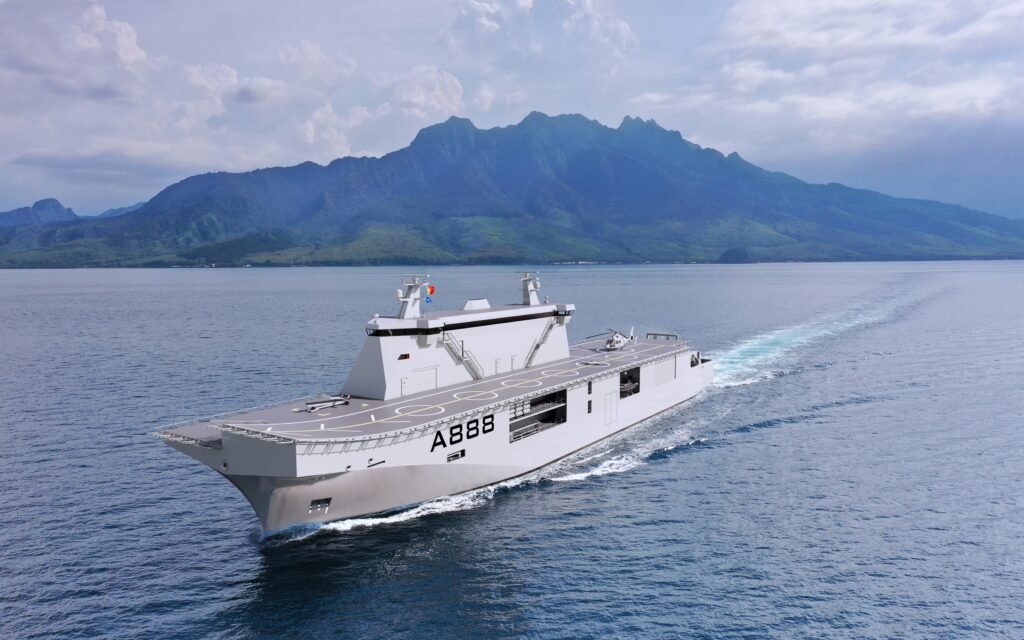
Design of the Portuguese Navy ship NRP D.Joã II. Source
The Portuguese Navy is currently constructing the NRP D.Joã II, a multifunction support ship designed to be Europe’s first dedicated drone carrier. It is scheduled to be delivered in late 2026. the 107 meter vessel features a 94-meter flight deck capable of launch light UAVs via catapult and support larger drones in both STOL and VTOL modes. It utilizes a stern ramp to deploy USVs and underwater vehicles (UUVs). It is unlike the other ships designed to conduct maritime surveillance, search and rescue operations but also oceanographic research. It is built by Damen Shipyards Group for an approximate cost of €132 million and designed for an autonomy of 45 days and a range of 10,000 nautical miles. It can also accommodate 18 containers, 10 boats and specialized scientific laboratories.
2. The Turkish Navy Ship TGC Anadolu
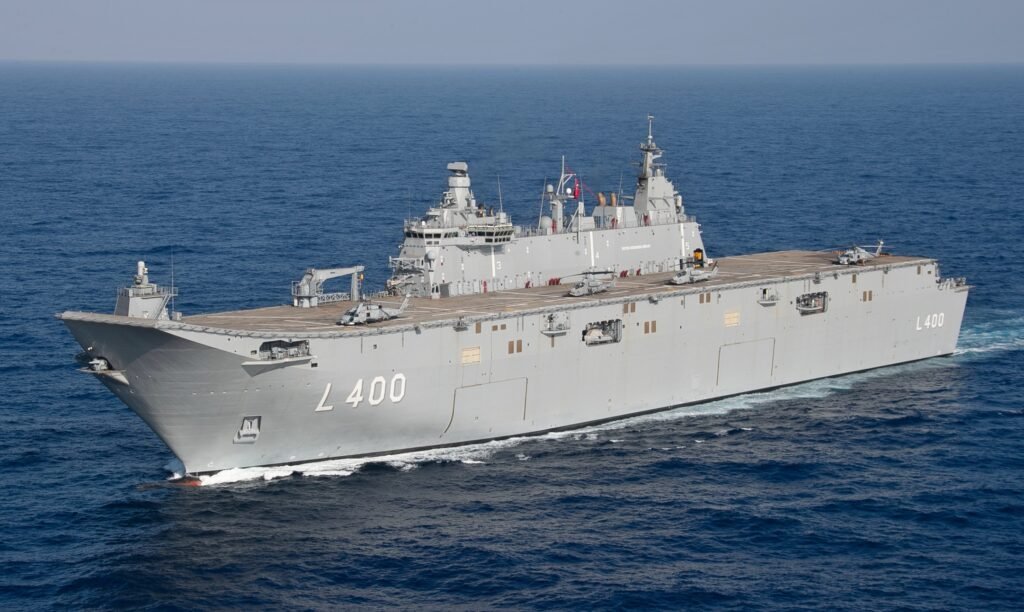
Turkish Navy amphibious assault ship TCG Anadolu in the Mediterranean. Source
The TCG Anadolu is recognized as the world’s first dedicated UAV carrier, a 27,436-ton vessel originally designed as an amphibious assault ship but modified after Turkey’s exit from the F-35 program. The 232-meter ship features a 12-degree ski-jump and specialized drone infrastructure, including satellite control terminals, a bow “roller system” for launches, and arresting gear for recovery. It is designed to host between 30 and 50 folding-winged Bayraktar TB3 drones, which successfully conducted their first carrier-based take-offs and landings in late 2024.Turkey also plans to integrate the jet-powered Kızılelma UCAV and the Anka-3 into the ship’s air wing to provide high-speed strike capabilities. Beyond its drone capacity, the ship can transport a battalion-sized amphibious force, armored vehicles like the Altay tank, and up to 10 Super Cobra helicopters. Equipped with the indigenous Advent Combat Management System, the Anadolu manages a diverse weapons suite including RAM missile launchers and close-in weapon systems (CIWS) for robust defense.
3. The Iranian Navy IRIS Shahid Bahman Bagheri
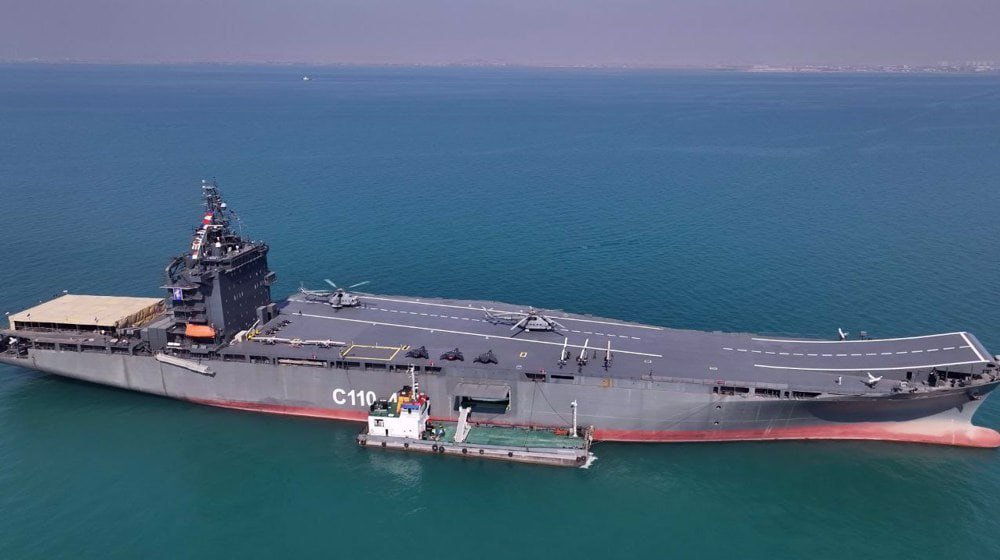
IRIS Shahid Bahman Bagheri off the coast of Iran. Source
The IRGC Navy recently commissioned the IRIS Shahid Bahman Bagheri, a massive 42,000-ton drone carrier converted from a South Korean-built commercial container ship. This 240-meter vessel is uniquely characterized by its 180-meter angled flight deck and integrated ski-jump, allowing it to function as a mobile base for long-range ISR and strike missions. It reportedly carries up to 60 drones from the Mohajer, Shahed, and Ababil families, and has displayed JAS-313 jet-powered UAVs on its deck. Beyond aerial operations, the carrier utilizes side-mounted davits to launch and recover up to 30 fast-attack missile boats, reinforcing Iran’s asymmetric naval doctrine. The ship is heavily armed for self-defense with Ghader anti-ship cruise missiles, Kowsar-222 air defense systems, and 30mm automatic cannons. Designed for significant blue-water reach, the Bagheri boasts a 22,000-mile range and can operate for an entire year without refueling. Its vast interior includes unconventional facilities for extended deployments, such as a hospital, a gymnasium, and even an astroturf soccer pitch for the crew.
These traditional naval drone carriers share several characteristics, the first one being their scale which is in theory linked to their ability to project power. The larger the ship, the more its able to project itself in an area using its weapon systems. The Portuguese Navy’s NRP D.Joã II has an announced displacement of 7,000 tons while the IRIS Shahid Bagheri has a displacement of around 42,000 tons (being a former container ship) which is more than some aircraft carriers such as Italy’s Cavour.
They also typically feature traditional aviation equipment like catapults, arresting wires and ski jumps. The Turkish Navy’s TCG Anadolu, which was originally designed to carry 20 F-35B SVTOL fighter jets (carrier variant of the F-35) which was then modified to fit it with Bayraktar TB-3 and TB-2 drones. The NRP Dom João II will include at least one catapult on the fight deck’s starboard bow to launch light UAVs. The ship also has a 94-meter runway which can support larger drones.
Finally, while these ships operate with uncrewed drones, they do still rely on a certain amount of manpower. Portugal’s carrier requires a crew of 48, South Korea’s 15,000-ton HCX-23 Plus concept is designed for roughly 100 personnel.
Overall, these drone carriers share a strategic role as an alternative to multi-billion dollar aircraft carriers offering a lower-cost to projecting air and naval power in an area of operation, alone or in coordination with allied forces. For all these countries however, these ships are not simply one of their most important tool in their arsenal, but the most important tool that forms the cornerstone of their naval strategy. While loosing the drones being used is excepted, the carrier not so much. So despite being a way yes innovative by reducing costs, manpower needs and reducing procurement time, it still does share a lot of the same characteristics in effect of a traditional aircraft carrier. the Portuguese Ship is designed to accommodate as well other aircraft and its Turkish counterpart was originally designed to use fighter jets. As such, these drone carriers are still relatively traditional platforms in the sense that they are flagships for their navies countries which need to be protected by a carrier strike group to insure its protection and operational freedom of action.
What is more revolutionnary is the emerging trend of drone “motherships”.
What are the key takeaways from the Emerging Trend?
Ukraine, a nation effectively without a traditional navy, has provided a masterclass in naval asymmetry by neutralizing approximately one-third of the Russian Black Sea Fleet. This was achieved through the rapid evolution of Unmanned Surface Vehicles (USVs) from simple “kamikaze” boats to sophisticated, multi-role combat platforms. The “Magura V5” recently made history by successfully engaging two Russian Mi-8 combat helicopters near Cape Tarkhankut. Armed with the R-73 “SeaDragon” (a navalized variant of the air-to-air missile), the Magura V5 proved that drone “wolf packs” now threaten not just vessels, but regional air superiority, resulting in the loss of 16 Russian personnel in a single engagement.
Further innovation is seen in the “Sea Baby” USV, which has been equipped with Italian MN103 “Manta” naval mines to seal narrow channels. Simultaneously, the Ukrainian Marine Corps has deployed the “Barracuda” river drone. Built by the 40th Coastal Defense Brigade, the Barracuda is a modular, AI-enabled vessel tailored for “Dnipro island warfare.” It performs mining, resupply, and strikes using mounted grenade launchers. Crucially, a strategist must note its tactical constraint: the Barracuda lacks satellite communications, limiting its range to short-distance missions where radio or line-of-sight control is maintained—a design choice reflecting its role in specific riverine contested zones.
“Sea Baby” USV being Deployed during test phases. Source
Perhaps the most significant development is the $250,000 remote-controlled “drone-drone-carrier.” These 18-foot vessels act as sea-based motherships for FPV aerial drones. By launching FPVs from the water, Ukraine has extended its reach five miles inland, striking Russian Pantsir and Osa anti-aircraft systems in deep Skadovsk. This “mothership” approach turns a sea-based weapon into a land-attack platform, bypassing coastal defences. Additionally, the “Alligator-9” platform has emerged as a high-end modular USV capable of carrying torpedoes or the Tryzub 90 laser system, codifying these improvised successes into purpose-built designs.
One thing important to note however is that these drones are operating in maritime confined spaces meaning that it remains to be seen whether these could be deployed in open seas with all the extra burdens that it entails such as an increased reliance on for instance satellite communications contrary to these other drones which have the luxury of relying on ground communications.
One thing is for sure however, defense companies in the western world have picked up on the usefulness of these drones and have already started showcasing new products, probably benefiting from Ukrainian expertise filling capability gaps.
Havoc in cooperation with Lockheed Martin and Vatn Systems have recently shown their Rampages integrated with Lockheed Martin’s UI and subsurface unmanned systems and utilizing Havoc’s AI software.
Havoc’s AI second Generation “Rampage” Being Deployed. Source
What has pushed the development of naval drone carriers and what does it mean for the future of maritime warfare?
The proliferation of low-cost drones has validated Captain Wayne Hughes’s prediction of “unstable circumstances,” where striking power far exceeds defensive survivability. This has manifested as a “losing dollar exchange” for traditional navies. During operations in the Red Sea, the US Navy encountered Houthi drones costing between $2,000 and $20,000. These were intercepted by SM-3 missiles costing approximately $15 million per round—an economic ratio of 1/750th in favor of the attacker.
Hughes’s Salvo Equations suggest that when striking power is high and defensive capacity is finite and expensive, the only viable strategy is to “fire effectively first.” The US Navy expended a year’s production of SM-3s in mere hours to defend against threats that, in total, cost less than two of their own interceptors. Lanchester’s Square Law, which historically favored the concentration of force, is being invalidated by these economics. In a world of “precision mass,” a defensive, attrition-based stance is a path to strategic bankruptcy. The defense industrial base’s inability to match the “fast fashion” cycle of drone development means that capital ships are increasingly vulnerable to being overwhelmed by salvos of $500 FPV drones.
The “Mass Effect” in modern naval geometry dictates that the battlefield is now “transparent” due to the saturation of low-cost sensors. In this “Zone of Contestation,” traditional concentration of force—once a prerequisite for victory—has become a liability. Lethality is currently increasing exponentially while protection (armor/missile defense) is increasing only logarithmically. Large formations now act as beacons for precision mass salvos.
To survive, forces must remain dispersed at range, condense rapidly for the duration of a strike, and then immediately disperse again. This requires persistent, long-range surveillance. France’s planned PANG aircraft carrier (service entry 2038) is addressing this by integrating the “Aarok” MALE UAV. Developed by Turgis Gaillard, the Aarok features a 1.5-tonne payload, 20-hour endurance, and can operate at altitudes of 15km. It serves as the “eyes” for the carrier, providing maritime surveillance and anti-submarine warfare capabilities from safely outside the immediate threat zone. This integration acknowledges the “Precision Mass” argument: when an FPV drone is 1/130th the cost of a Javelin missile, quantity becomes a quality of its own. High-end platforms like PANG must now rely on drone “screens” to navigate a geometry where even small actors can launch saturation attacks.
Modern naval warfare is currently gripped by the “Red Queen Effect”—an evolutionary race where platforms must innovate at maximum speed just to maintain their current strategic position. Traditional naval procurement, characterized by 20-year development cycles and 50-year hull lifespans, is fundamentally incompatible with a “Fast Fashion” drone environment where software and hardware iterate in 12-week cycles. This acceleration is driven by the collapse in the cost and weight of compute power, a derivative of Moore’s Law that has triggered Jevons’s Paradox in the military sphere.
Conclusion
The drone carrier revolution is not merely the introduction of a new ship type; it is a fundamental shift in the character of war. The era of the carrier monopoly has ended, replaced by a distributed, high-lethality environment where economic efficiency is as critical as kinetic power.
The critical takeaways for planners and economists are:
Failing to adapt to the economics of “precision mass” will leave traditional navies as little more than high-value targets—capital ships inevitably falling to the cold logic of Hughes’s equations.

Analyst in the defense industry offering insights in the drone sector
https://en.wikipedia.org/w/index.php?title=Drone_carrier&oldid=1335788344
https://press.armywarcollege.edu/parameters
The Pursuit of Drone Carriers by Portugal, Iran, and Türkiye
The Telegraph: Ukraine’s new $ 250,000 naval drone carriers strike Russians by sea and air
Ukraine’s Drone Armada Evolves: From Black Sea Battle Labs to Modular Multi-Mission USVs
[https://euromaidanpress.com/2025/11/21/ukrainian-barracuda-naval-drone-blow-up-russian-logistics-base/
www.bairdmaritime.com
https://lnkd.in/eZihpBSz
https://lnkd.in/ehNKG4Kc
https://lnkd.in/e82zrjyd
https://lnkd.in/e324hdGY
https://lnkd.in/eCr7bduu
https://lnkd.in/ehQDtYAi
https://downrangedata.substack.com/
Norway to Fund Development and Production of Naval Drones in Ukraine
https://www.lepoint.fr/monde/joao-ii-le-projet-ultra-innovant-de-la-marine-portugaise-26-12-2023-2548287_24.php
https://www.meretmarine.com/fr/defense/le-batiment-porte-drones-nouveau-gadget-porte-avions-low-cost-ou-future-classe-de-batiments
https://www.meretmarine.com/fr/defense/la-chine-lance-le-premier-lhd-porte-drones-dote-d-une-catapulte-et-de-brins-d-arret

_steams_in_the_Mediterranean_Sea.jpg)
#/media/File:ShahidBagheri.jpg)