
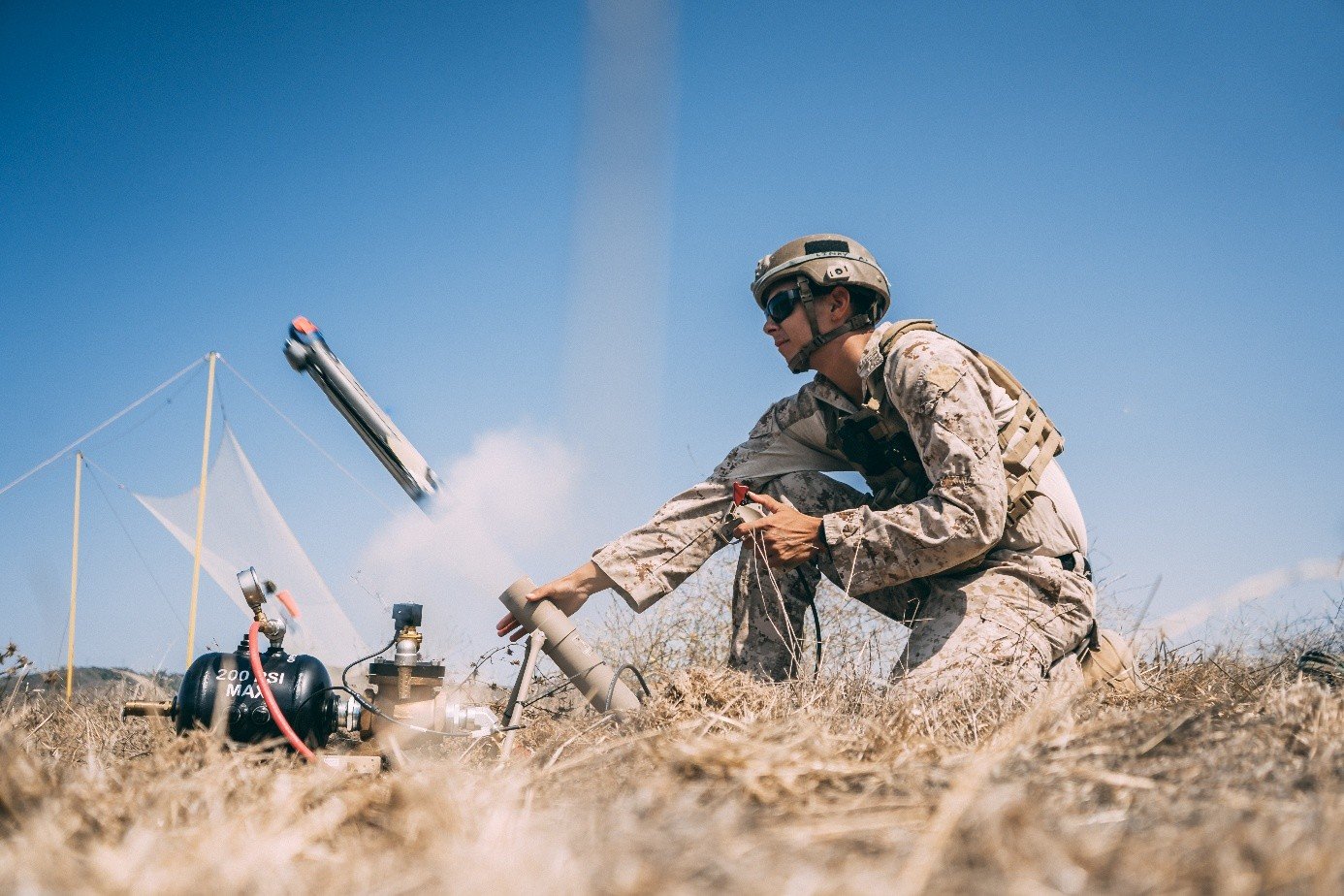
A Switchblade 300 being fired by a U.S. Marine Corps Corporal during an exercice. Source
Over the last few years, the modern battlefield has seen rapid evolutions. Conflicts have always been a breeding ground for technological and doctrinal breakthroughs. As such, is it often tempting to attribute shifts in procurement and the development of products to highly visible conflicts (especially in the information age). The War in Ukraine has particularly put centre stage the use of loitering munitions and by extension drones, by both parties.
Through the lens of traditional media, one might assume that although drones were previously used for precision strikes, it is only in recent armed conflicts that their role has shifted towards more tactical applications with your babushka running a factory in her basement.
During the war in Afghanistan, the U.S. military was faced (as often in its history) with counterinsurgency operations, and it was at this time that loitering munitions resurfaced in the 2000s with the introduction of the Switchblade family.
What is a loitering munition?
A loitering munition is first an aerial weapon system (a flying precision-guided weapon if you prefer) that can fly over areas of interest during a predefined period, acting as one platform both providing ISR (Intelligence, Surveillance, Reconnaissance) and immediate strike capabilities by itself (the drone is the payload unlike drones dropping munitions) and has autonomous or automated capabilities (unlike drone-missiles which are “dumb” as there is no way to guide them after the launch phase, some possess operators-in-loop).
A loitering munition goes through four phases: launch phase, manoeuvre phase, loiter phase, strike phase (and possibly return to launch pad).
If you follow what’s going in the drone defence space, then the Switchblade family will be familiar to you. If you haven’t heard about it, here’s a rundown: The Switchblade family is a set of loitering munitions produced by AeroVironment fielded since 2011. According to the company, it has built 3,000 of its 600 block 1 variant. It was awarded in August 2024 a $990 million by the U.S. Army for an indefinite delivery and indefinite quantity contract for its loitering munitions products, making it one of the key players in the sector. Besides the United States and Ukraine as customers, documented purchases/foreign military sales or announced acquisitions include Lithuania, Romania, Sweden, France, Greece, Australia, Canada and Taiwan.
But why talk about the Switchblade series? As a product series, it has been commercially successful in open commercial sales, excluding Ukraine, having a strong presence in Western defence markets.
More importantly, it symbolizes the fact that the relative trend of shift from low-cost munitions to conventional missiles isn’t simply a radical shift, but the result of a long process that has accelerated in the last few years.
Furthermore, the United States of America has been a pioneer in drone warfare, but the Russo-Ukrainian War has moved drone technology to the forefront of battlefield weaponry.
In this article I therefore will explore how the Switchblade family exemplifies the shift in military procurement from counterinsurgency operations to confrontation with a peer or near peer adversaries in the Western world and whether the Switchblade is adapted to the market and its competitors.
Nota Bene: the Blackwing will be not included in this article, even if it considered to be part of the same family and a variant of the Switchblade 300, as it is not considered a loitering munition according to the author’s definition (see section for more details).
Why was the Switchblade 300 developed?
The Switchblade 300 was initially developed in 2004 following the U.S. Army request to AeroVironment for a small UAV that could be launched from a 105mm mortar to quickly assess battle damage. To put it simply, the soldiers wanted to know whether they were hitting anything worthwhile, or whether the enemy had already gone once they had been ambushed by insurgents.
In 2006, AeroVironment was awarded a SBIR (Small Business Innovation Research) contract from the Air Force Research Lab to develop a Switchblade-armed UAV after having approached Air Force Special Operations Command (AFSOC), seeing as something relatively stealthy and precise is in the job description of Special Forces.
The U.S. Army became aware of this capability in 2010 and conducted a user operational assessment (UOA) in-theatre. This led to further investments and the fielding of the Switchblade Block 10 to Afghanistan in 2012 following further funding from the U.S. Army.
The development of the Switchblade allowed the US Army to fill a gap in their weapon capabilities by deploying a weapon system able to deliver an effective payload while minimising collateral damage.
The “Block 10” variants used a warhead creating a forward-firing shotgun-blast, meaning that the blast could be circumscribed and directed more effectively than conventional 360 degrees explosives (hand grenades, mortars, shells) according to William Nochols, former LMAMS product director the U.S. Army’s Program Executive Office for Missiles and Space.
This also includes the ability to be able to recall the drone prior to detonation and wave-off the strike, which has been used several times to avoid civilian casualties during its emergency deployment starting in 2012.
This led to further investment and interest as it was deployed in the field. In 2013, the former Secretary of Defence applied the Rapid Acquisition Authority provision of Public Law 107-314, allowing the Secretary of the Army to bypass certain regulations and laws to allocate DoD funds to increase the delivery rate of the Switchblade. $40 million in funds were allocated.
Switchblade 300 Block 20 commercial video presentation. Source.
How has the Switchblade evolved?
The Switchblade 300 Block 10 was designed as a weapon system to fill operational needs of US Armed Forces in their counterinsurgency operations. Its development and production were supported through the allocation of rapid funding for innovative weapon systems. The Switchblade family expanded with the introduction of the multi-pack launcher, developed as a close-range counter battery response to troops taking indirect fire (30 seconds reload speed) while limiting casualties. It was specifically designed to support forward operating bases. As this stage, the Switchblade’s use is still tailored to counterinsurgency operations. The idea of using it against a conventional forces was probably still at this stage far from the minds of the engineers and generals in the room.
Although, through the introduction of the Switchblade 600 we start seeing a shift on the usage of these drones and adapting it for an adversary with symmetric capabilities by giving it the ability to operate in a denied or degraded environments through the integration of artificial intelligence and of a larger, anti-armour warhead which would be used against armoured targets.
Basically, whereas before the 300 variant was a hammer, then the 600 would be a sledgehammer offering a lot more firepower for bigger targets.
What’s interesting to note as well is that this offers a new capability to operators on the ground. If air assets are unavailable in an area of operation, this new type of loitering munition gave the ability to counteract armoured threats at a tactical level, thus reducing the dependence on conventional aircrafts for reconnaissance and strike support.
Even if the United States has the biggest and most modern fighting force in the world, if it can use the taxpayer’s money more efficiently, then it will. At the end of the day, war comes down to economics and how effectively you’re spending your money for what purpose.
The introduction of the Switchblade 600 can also be seen as AeroVironment challenging the conventional missile systems market, offering a more versatile product serving as a precursor to an increased reliance in armed forces on drone systems, and more precisely loitering munitions, several years before highly publicized conflicts.
Lessons learnt in Ukraine
Several lessons were learned by AeroVironment throughout the course of the ongoing war in Ukraine.
The first one being cost and further diversifying its product lines compared to conventional missile systems through the announcement of the Block 20 version of the Switchblade 300, the reveal of the Switchblade 400 and the upgrade of the Switchblade 600.
Switchblade 600 Block 2 commercial video presentation. Source.
The previous lineups of products were simply not price competitive compared to say a Javelin anti-tank missile. The Switchblade 300 Block 10 is rumoured to cost $53,000 per unit (allegedly $80,000 after taking account development) while the Javelin costs $184,000 per missile. The 300 is however only designed to engage infantry which the begs the question of the actual price of the Switchblade 600 that is currently not publicly available which is probably higher considering it is larger than its smaller brother.
The new Switchblade 400 that was announced is probably the company’s answer to this question. It is specifically designed to target tanks and heavily armoured vehicles. It is also tailored for the LASSO program and includes a javelin multipurpose warhead and optics as well as a rocket assisted take-off.
What is the Low Altitude Stalking and Strike Ordnance (LASSO) program?
The LASSO program is a US Army program launched to provide soldiers with a portable loitering munition to penetrate light or heavily armoured vehicles. The army is considering acquiring several different products to address various air defence needs.
The LASSO drone will consist of three parts: a launch tube, a powerful UAV, and a fire-control station.
Active procurement, development and fielding appear to continue as of 2025.
Switchblade 400 commercial video presentation. Source.
The ability of the new Switchblade 300 Block 20 to operate in electronic warfare environments is probably as well a direct result of feedback from usage in Ukraine as poor countermeasures have seen a high attrition in drones. With added “plug and play” technologies, the 300 is becoming an increasingly versatile product for users, allowing them to integrate these products on different platforms (by probably making it compatible with open source software which is heavily used in Ukraine)
This goes hand in hand with AV mentioning in a recent press release its willingness to rapidly expand its switchblade series manufacturing capabilities as high production rates have become crucial for usage but also for winning bids. Companies not being able to deliver a low-cost product on mass will face increasing difficulties in finding willing customers as the geopolitical tensions and potential armed conflicts loom requiring en masse production.
Finally, the SW 600 block 2 version adds a new secondary payload bay to conduct more diverse missions (as of today unspecified). AV has also started producing them in Ukraine with a local company, allowing it to adapt the product at a faster rate to their customers’ needs.
Originally designed as a UAV, the Switchblade has seen rapid evolution and changes making it a model and a precursor to the trends currently unfolding on the drone market. By constantly innovating, armed forces support and government funding, the switchblade family has expanded and continues to grow to this day. It embodies the shifting interest seen today in military procurement for low-cost munitions to growing threats but remaining competitive with conventional missile systems.
Conclusion
While several new products are emerging on the market, it is difficult at this stage to say how many will be able to emulate the success of the Switchblade series and if they will be able to stay on the market in the next few years.
The Switchblade series (and more particularly the Switchblade 300) exemplifies the short cycle from concept to development and to maturity of loitering munitions – rapidly deployed and field tested first in small quantities, then improved and used progressively by more units and corps as its capabilities are developed.

Analyst in the defense industry offering insights in the drone sector
https://www.defensenews.com/air/2025/10/13/aerovironment-eyes-new-factory-drone-launches-for-s
https://www.defensenews.com/land/2020/10/01/aerovironment-debuts-bigger-anti-armor-loitering-missile/
https://www.war.gov/News/Contracts/Contract/Article/3886803/
https://milmag.pl/en/switchblade-loitering-munitions-for-three-nato-countries
https://www.avinc.com/resources/press-releases/view/aerovironment-awarded-64.6-million-contract-by-u.s-army-for-switchblade-300-loitering-missile-systems
https://www.avinc.com/images/uploads/news/2020_Use_Case_Switchblade_Final.pdf
https://www.avinc.com/images/uploads/product_docs/Switchblade-300B20_Datasheet_v04.pdf
https://www.avinc.com/images/uploads/product_docs/MPL_Data_Sheet_2017_Web_v1.2.pdf
https://www.avinc.com/images/uploads/product_docs/2025_SB400_Datasheet_250930_v11.pdf
https://www.avinc.com/images/uploads/product_docs/2025_ProductCatalog.pdf
https://www.avinc.com/resources/press-releases/view/av-unveils-next-generation-of-switchblade-loitering-munitions
https://www.avinc.com/resources/press-releases/view/av-unveils-next-generation-of-switchblade-loitering-munitions
https://web.archive.org/web/20150919193839/
http://www.c4isrnet.com/story/military-tech/omr/missile-defense/2015/08/13/kamikaze-drones-add-new-layer-lethality-remote-forces/31405521/
https://comptroller.war.gov/Portals/45/Documents/afr/fy2013/2-MDA.pdf.
https://www.nationaldefensemagazine.org/articles/2019/7/16/multi-pack-launcher-deployed-for-switchblade
https://newatlas.com/military/switchblade-600-loitering-drone/
https://thedefensepost.com/2023/08/11/us-army-drone-variants/
https://thedefensepost.com/2023/08/11/us-army-drone-variants/
https://www.armyrecognition.com/archives/archives-land-defense/land-defense-2024/new-us-switchblade-300-block-20-loitering-munition-now-operates-in-electronic-warfare-environments
https://www.businesswire.com/news/home/20251013724581/en/AV-Unveils-Next-Generation-of-Switchblade-Loitering-Munitions
https://www.businesswire.com/news/home/20251013724581/en/AV-Unveils-Next-Generation-of-Switchblade-Loitering-Munitions